Thursday, October 30, 2014

Saint, Maybe: Bill Murray in "St. Vincent"


Vinnie is no saint. At least, that’s what most people who know him think. He’s a drunk and a gambler who spends time with a, um, “lady of the night.” When his new neighbors move in, a newly-single mother named Maggie and her son Oliver, he isn’t exactly the neighborhood welcome wagon. Maggie has a new job and no one else to turn to, so she asks Vinnie to watch Oliver after school.

Oliver begins attending a Catholic school, where his priest-teacher is a warm and kind person. Unfortunately the kids aren’t so nice, and Oliver is bullied. Vinnie teaches him some self-defense. Vinnie also takes him to the horse track and the local bar. He’s sorely lacking in good judgment as relates to childcare, or to his own life for that matter. On the other hand, Oliver accompanies him to the nursing home, where Vinnie regularly cares for a loved one. Oliver starts to see a different side of Vinnie.

Bill Murray plays this man of no moral standing quite convincingly, though he’s still likeable in some way. It’s possible this movie would be more effective if the neighbor weren’t someone I have always liked. I’m predisposed. I must not be the only one, because this theater was packed. This isn’t the kind of movie that generally packs in a crowd!

Murray’s is not the only strong performance. Melissa McCarthy plays Maggie. I have only ever known McCarthy from her female gross-out roles in things like Bridesmaids and Saturday Night Live skits. About two weeks ago I found a completely new side of her that many already knew about—I started watching the old TV series Gilmore Girls, and McCarthy is the sweet, bumbling cook who is best friends with Lorelai Gilmore. I love her in the show.

St. Vincent gives her something more to do with her acting chops. She definitely draws out some laughs, but Maggie takes a heartbreaking turn when she confesses to Oliver’s teacher the difficulties of her new life and the pain caused by her former husband.

And then there’s the prostitute, a pregnant Russian stripper, played with relish by Naomi Watts. Brian and I both spent some time trying to figure out where we’d seen this Russian actress before, until after the movie when we realized it was the Aussie actress. She brings another dimension to Vinnie’s character.

This movie is sappy and predictable; it’s also warm and full of a weird kind of joy. These people are dealing with the day-to-day dirt of life, and there’s no easy way out for any of them. No one turns into someone completely different; they are who they are. But they are slowly learning more about themselves and the people around them. They are finding the good hidden under the hard edges and the tough words. Although this movie is about a more humanistic variety of saints, we Christians might see it as finding the image of Christ that is in everyone. And that’s what we're supposed to be all about.


Friday, October 24, 2014

A Very Lively "Book of Life"


This animated ode to the Mexican holiday the Day of the Dead is a colorful, folk-art inspired vision. It’s also a bit confusing, both in storyline and in spirituality. I think it would be a lot for a small child to try to take in. I took my 11-year-old, who found it entertaining and interesting.

The animation is unusual because the characters are all meant to be wooden figures, and so their movement and body structure is very different from the ever-more-lifelike computer animation in many movies.

Manolo and Joaquin are competing for the lovely and independent Maria’s heart. Manolo wants to be a musician, but his family tradition is bullfighting. Joaquin’s father was a brave defender of the town, so Joaquin is also feeling pressure to follow in his footsteps.

The story is told during the celebration of the Day of the Dead, which is a time when people put out food and gifts for their deceased loved ones, remembering their time on earth. It is the way that the living show respect and love for those who have come before. This thread complements the fact that Manolo, Joaquin, and Maria are all trying to find the paths they will follow, even while they are heavily influenced by what their families desire from them.

At the same time, La Muerte, who rules the beautiful and wondrous Land of the Remembered, and Xibalba, who rules the sad and colorless Land of the Forgotten, make a wager over which young man will win Maria’s hand in marriage. Xibalba’s trickery leads to the death of one of the young men, who makes a dangerous journey back to the land of the living to save Maria and their town from a terrible bandit.

There are all kinds of spiritual components to the story, which would make good discussion starters with a child who is open to it. How does the Land of the Remembered compare to a new earth? How does the Land of the Forgotten compare to hell? How much of our lives are predetermined and how much is free will? You don’t get those kind of spiritual questions from Monsters University! I’d take kids ages 8-12, and I’d plan to ask some deeper questions on the way home.

Plus we live in a country that is increasingly influenced by our neighbors to the south, so it seems like a little cultural education might be a good thing.

Strangely, in the midst of a very Mexican-looking movie, you have pop culture references to Mumford & Sons, Radiohead, and Biz Markie, among others. A 20-something man in the audience burst out laughing when he recognized one song before everyone else. Which is fun if you are into spotting such things, which I am, but doesn’t really seem to fit the tone of the movie.

All in all, this is a fun movie with lots to think about and even more visual beauty to wonder at. But parents should take seriously the spiritual terrain it covers.


Thursday, October 16, 2014

Reliving My Boy's "Boyhood"


Boyhood follows the life of a boy, Mason, and it was filmed over 12 years as he grew from youngster until he left for college. Sounds like a documentary, but it’s not. Boyhood presents a fictional boy from a fictional dysfunctional family, but the actors were all filmed over a 12-year period. It makes for a unique movie experience.

This movie isn’t driven by a neat story arc—the plot is more like life itself, meandering through events and phases. But you still want to see what happens next. The fact that I can say that when the movie is almost three hours long tells me that the director, Richard Linklater (Before Sunrise, Before Midnight), has definitely gotten something right here.

As my son is just a year or two younger than the boy in the movie, it was fascinating to revisit so much of the culture we’ve moved through. I brought Andrew to a midnight release party for the seventh Harry Potter book, just as in the movie. Ethan Hawke’s character is reading Into Thin Air right about the time I did. He has run through his own string of video games in much the same order as Mason. We even had the same 20 Questions gadget.

It’s a gutsy move for a director, counting on the fact that none of his actors will drop out or be forced to drop out of the filming over that long of a time period. He had to gamble on the kids who would grow up in the film, hoping they would turn out to be good actors. In particular the boy in question needed to turn out to be a good actor. It worked out for him; Ellar Coltrane delivers a great performance as a young man struggling to see what future he should be chasing.

But the director is not the only one taking risks. It seems to me a pretty gutsy move for actors too. Especially for Patricia Arquette, who plays his mother. It’s not likely to be flattering to see yourself age, for real, in a movie that you started in as a young adult (though I would argue she was not young enough for this role) and ended squarely in middle age. Especially when your character has very questionable taste in fashion. Somewhere in the middle viewers see her as she appeared in the TV show “Medium,” if you remember such things. Arquette takes on this challenge, playing an intelligent, caring mother who has some serious flaws and makes a few terrible life choices.

Ethan Hawke, who plays Mason’s dad, ages too, but let’s be real, it’s never as flattering for the woman. Plus you get the feeling they make him look dorkier as he ages on purpose—I think he hasn’t really changed all that much.

This movie gives you a sense of how much happens in twelve years, and also how quickly it goes by for the adults. As Arquette’s character says toward the end, “I thought there was going to be more!” That’s a sentiment any of us of a certain age have experienced at one time or another.

While the parents are busy getting on with their lives and trying to make something more for themselves, sometimes the children are just collateral damage along the way. At moments you (or at least I) want to shake the parents into thinking about what they are doing. And the advice they hand out to their kids is for the most part a fistful of nothing. At one point he admits that when Mason and his sister were babies, he had no concern for the state of their souls. It seems that this is true of most of the adults in their lives. If nothing else, the movie might make you feel better about your own parenting!

So, mothers of teen boys who will soon be testing their wings, beware, this may hit too close to home. But it’s a fascinating look at the fleeting nature of youth, of life in general. At the end you may be whisked right back to being 18 or 19, when the whole world awaited.

Thursday, March 27, 2014

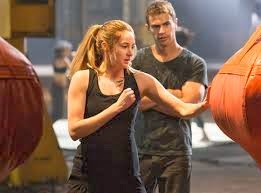
Divergent: Does it Diverge from the Book?

Chicago is ruined, inhabited by five different factions. Abnegation strives for total selflessness.
Erudite seeks knowledge. Candor speaks only the truth. Amity aims for peace, avoiding all conflict. And the Dauntless seek to embody bravery. At the age of 16, young adults must choose the faction that they will join, leaving their families behind forever if their choice is different from their parents’. Let’s just say that at 16 I probably would have chosen anything but my parents’ choices!

Tris, who grew up in Abnegation, decides to join the Dauntless. The tests she takes to make this decision are supposed to make the choice obvious, but her tests turn up something unusual—she is Divergent, which is a fact she’s supposed to hide from everyone.

Her Dauntless initiation is violent and disturbing, but it’s also loaded with the kind of sexual tension that would have had me riveted as a teen and still keeps my attention as a middle-aged lady. However, I never have appreciated the kind of violence that characterizes the Dauntless rite of passage, a beatdown that no longer adheres to the original goals of the faction that seeks to instill courage. Instead, it breeds cruelty. And the Divergent are seen as a danger. Plus, one wonders why a futuristic society that can come up with some sort of electronic tattooing device can't find a way to make boxing gloves.

Shailene Woodley, who has demonstrated her acting chops in The Descendants and The Spectacular Now, plays Tris. Theo James takes on the part of the complex and conflicted hottie named Four, Tris’s instructor and possible love interest. They are great; they are just better than the movie itself. And I can't wait to see Woodley in The Fault in Our Stars later this year.

The heroes of Divergent are defined by one characteristic, a situation with which a few of them are discontent. They long to be more. But they have been reared to believe that the ultimate goal is to embody one characteristic. Which gets complicated when you start feeling compassion toward a rival, or when you are willing to bravely sacrifice yourself for someone you love.

The author, Veronica Roth, has mentioned on her blog that she started writing Tris’s character as a way to combat her own anxiety, a way to be brave and take control. This is certainly a theme that would resonate with any teen.

Unfortunately, the movie doesn’t do justice to the book. Even my 15-year-old daughter, a Divergent fan, thought that it was basically just a typical action movie. I don’t think her opinion was shared by all of the opening-night crowd, which cheered at many violent moments in the film. And then there was the older woman behind me, who at a particularly violent moment, exclaimed her discomfort with the events.

Divergent the movie has lost track of the soul of the books they are based on—Tris’s innocence, the desire to be more than what they have chosen, and the relationship that is more than just the sexual tension. The movie version of Divergent is less challenging and less interesting than the book from which it arose, leaving the film a bit hollow, like the factions themselves.

Thursday, March 13, 2014

Miyazaki's Rising Wind


Last week I took 4 Miyazaki nerds to see his latest movie, The Wind Rises. What is a Miyazaki nerd, you may ask? Well, you obviously don’t live in my house.

Two and a half Miyazaki nerds live in my house. The ‘half’ is the youngest child, who might not have been such a nerd if not influenced by the two older siblings. What is a Miyazaki? Well.

Hayao Miyazaki is a legend of Japanese animation. He has made many, many movies, and a good number of them have become known to American audiences (Ponyo, My Neighbor Totoro, Spirited Away, Castle in the Sky to name a few). And my kids happen to love them.

So, when they heard that he was retiring, and The Wind Rises was going to be his last film, the older two couldn’t wait to see it. And it was worth the wait, even though he seems to have once again retracted his desire to retire.

The Wind Rises is based on the life of Jiro Hirokoshi, a Japanese airplane designer. In the movie, he came of age just after World War I, dreaming of the beautiful machines he could design. He dreamed, literally, of meeting his hero, Italian plane designer Giovanni Caproni, who encouraged him to follow his dreams.

If you’ve seen any of Miyazaki’s other movies, you know there is always a whimsical and mystical quality to them. Even as he carries out a biographical movie, Jiro’s dreams allow for the magical element.

At the same time, Miyazaki gives us an epic historical movie of Japan, illustrating the great earthquake that hit Tokyo and the surrounding area, as well as the effects of poverty and war.

And then there is the romance, which I think affected the young viewers who accompanied me as much as anything. It is a sweet and melancholy romance, marked by devotion and tragedy.

In case you see the title Ponyo and think you should bring your young child to see this film, please don’t. It deals with war and devastation and illness. On top of that is some of the most attractive smoking I’ve ever seen in a movie. I don’t think I’ve ever wanted to smoke this much since the days of candy cigarettes, when my friends and I practiced how cool we would look if we actually could stand to smoke a cigarette.

Here’s the thing. Jiro’s primetime of life occurred in the time between World War I and World War II. We don’t get to choose the time period in which we exist. And all Jiro wanted to do was design airplanes. In Japan, at that time, the only group producing planes was the military. Which means that all his beautiful dreams were funneled into producing bombers that resulted in a lot of devastation during World War II. Are we responsible to use our gifts in ethical and morally responsible ways?

Since Miyazaki seems to portray Jiro as an alter-ego to himself, making “beautiful things”, it feels like he leaves Jiro off the hook for this ethical and moral dilemma. The movie presents a beautiful, moving opportunity to talk about what that means.

The refrain of the movie comes from a poem by French poet ValĂ©ry: “the wind is rising, we must try to live.” This echoes the experience of the main characters who, like us, are stuck in a very particular place and time, and they must make the most of it.

Thursday, March 6, 2014

Son of God and the Pitfalls of Biblical Moviemaking

I will admit to going into this one a bit wary. I’m always ready to cringe when anyone brings a Bible story to life. It’s so easy for these movies turn a vast, extraordinarily complex story, shot through with both light and darkness, into something with poor production values and a smarmy feel to it. I’ve heard The Passion of the Christ is good filmmaking, but the reports of flying flesh during flogging scenes have kept away from it. Violence is probably the thing I tolerate least in movies.

But I went to Son of God anyway. And in some ways, my fears were realized. There were some poor production values. The chief problem is the pace. The first part of the movies whizzes you through the highlights reel of the Old Testament, then the birth and life of Christ get a bit more airtime. From the Last Supper on, it slows down to a crawl. At the end there are lots of close ups of agonized and emotional people in slow motion, and the music plays on loudly. It reminded me of a critic who complained that the movie War Horse had too much “inspirational plowing.”

Also, as I had mentioned to the Friday Noon Movie Club, there is the problem of Jesus. He still looks way too much like the traditional Western image of him. In fact, he looks like Brad Pitt with some smudges on his face. I liked the actors who played John and Peter, and they looked like they might actually be from that time and place. I’ve nothing against the appealing Diogo Morgado who portrays Christ, but he does not appear to be from the pre-orthodontia phase of the world, which becomes quite obvious as he’s reduced to smiling spiritually much of the time. I wanted to see him righteously angry when he turned the tables over in the temple, but Morgado couldn’t quite summon up that kind of strength.

Personally, I think that filmmakers often fail at this because we just don’t know the man Christ well enough. We know enough to model our lives after him as best we can, but as has often been pointed out, it’s not so simple to decide things based on What Would Jesus Do. He was a mystery, and he was God. Even the disciples wondered what he was talking about half the time.

All that said, there were a few things I took away from this film.

First, though the character of Pontius Pilate comes off ridiculously at the beginning, in the end I appreciated some aspects of his characterization. The film makes clear the kind of politics he is dealing with. He allows his concerns for himself and his position to overtake his desire to do the right thing. At the end, as he tells his wife that it’s no matter, that this won’t mean anything, you see a person who is on the way to convincing himself that he is right. The Bible often mentions someone’s heart being hardened, which I’ve always wondered about. This gave me a glimpse of what that might actually look like.

Second, while I wished for more stellar cinematography (see the IMAX movie Jerusalem if you really want to have this old city take your breath away), I still felt like a got a feeling of what life was like then. Particularly what it means to journey from one place to another on foot in the arid land.

And, of course, I was reminded again of just what Christ’s sacrifice really was. I’m a very story-driven person, which is why movies appeal to me so much in the first place. A fleshed-out version of these events brings me a fresh reminder of what is so easily glossed over as I speak the words of the Apostles’ Creed.

And so, don’t go to this for great moviemaking. But if you want a taste of the land, or the life, or how some miracles might have looked, or most of all a fresh reminder of what price Christ paid, it might be worth your time.

Thursday, February 20, 2014

Saving Mr. Banks


Those of us attending the Friday Noon Movie Club last week were taken by surprise. We knew the basic idea of Saving Mr. Banks: P. L. Travers, curmudgeonly author of Mary Poppins, was reluctant to let her book become a Disney movie, and Mr. Walt Disney somehow convinces her to allow it. I even knew that it had something to do with her traumatic childhood experiences.

As it turns out, about half of the movie is dedicated to flashbacks to her childhood and the tragic nature of her father’s life. For at least one of us, the loss of a beloved, flawed father is fresh enough history that the movie prompted a new wave of grief. This movie is at least as much a father-daughter film as it is movie history.

Emma Thompson was, as expected, spectacularly crusty as Mrs. Travers, a woman aghast at the prospect of her characters joining the ranks of Mickey Mouse and Donald Duck. Thompson also gave her Travers a few fleeting moments of vulnerability that made her sympathetic in spite of her unrelenting sharp edges.

Tom Hanks plays Walt Disney, and he does it capably. It seems like a sort of thankless role, really, because he has no choice but to be affable and smart, and fit the mold of someone who created the Happiest Place on Earth. Which can only feel like propaganda. And in this movie, Disney & co. is truly a Happy Place. Everyone is smiling, and the writers and the administrative assistants seem just this side of cartoon characters themselves. They are charming and entertaining, and it’s fun to see how they deal with this gruff woman.

But if Thompson weren’t so good at straddling the line between crustiness and humanity, the adult-Travers portion of the movie would be way too saccharine. And we can only wonder if Walt himself is the real reason that Mary Poppins became a movie. Was he really that good a student of human nature? I guess it’s fairly obvious he read human nature right on a couple of points, or he wouldn’t have been so successful.

The movie is also a bit long, possibly testing some viewers’ patience; the sad story of her family may also be a bit much for the young ones. Our viewing seemed to be populated by women in their 30s and 40s, which is not the usual crowd for Friday noon movies—often I’m surrounded by either retirees or younger men who may possibly be escaping their life in their parents’ basement for the afternoon.

I do think it’s a shame that Emma Thompson wasn’t nominated for this, though Cate Blanchett has the Oscar all but wrapped up. I don’t really think Amy Adams has anything on Emma for this one.

This was a fun and touching way to spend a couple of hours with friends, and I recommend it for anyone who likes Mary Poppins, Emma Thompson, or indulging in a bit of orneriness.